Emphasizing the theme “Leveraging Technology and Innovation for Smart, Inclusive, and Responsive Parliaments,” the committee underscores the importance of digital transformation in strengthening parliamentary functions and citizen engagement.
Author: rwindwaai
-
Standing Committee on Trade, Industry, Finance, and Investment (TIFI) to Discuss AfCFTA
The TIFI Standing Committee is scheduled to deliberate on leveraging the African Continental Free Trade Area (AfCFTA) for post-COVID economic recovery. Discussions will focus on enhancing intra-African trade and industrialization strategies
-
Executive Committee Approves Business for Upcoming Plenary Assembly
The Executive Committee convened to finalize and approve the agenda for the forthcoming Plenary Assembly Session. Key topics include regional economic integration, legislative harmonization, and strategies to combat emerging challenges within the SADC region.
-
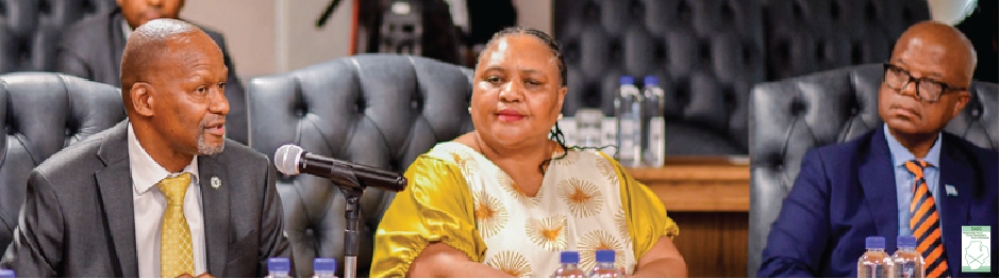
Calls for Swift Ratification of Regional Treaties
Gaborone, Botswana – The Executive Secretary of SADC, Mr. Elias Magosi, has hailed the recent signing of the Agreement to amend the SADC Treaty to transform the SADC Parliamentary Forum (SADC PF) into a regional parliament by Botswana’s President Advocate Duma Boko.
He, however, called for the active involvement of the region’s parliaments to ensure swift ratification of regional instruments.
President Boko signed the Agreement in Gaborone on Wednesday. Mr Magosi, in delivering a vote of thanks after the signing, called it a “momentous occasion” and a critical step towards regional integration, accountability, and enhanced governance.
He commended the leadership of President Boko, the Government of Botswana, and all those who worked over the years to reach this milestone.
“We did not despair,” Mr Magosi said, adding, “There have been layers of leaders that have come before you to lay the foundation and here we are now with you signing this important instrument. We must commend the country and the previous leaders, but we must commend you that you came in a short space of time, and you found it very, very important to append the signature.”
Mr Magosi stressed that the establishment of a regional parliament is not just symbolic, but a necessary evolution in SADC’s institutional development, especially for enhancing democratic governance, oversight, and the harmonisation of laws across member states.
“It is there to make sure that it enhances governance of our region such that we also perform effectively,” he said.
He added, “The laws that are there need an independent voice, an independent eye that makes sure that the region and the respective member states follow laws in the manner that serves our region, our member states and our citizens.”
However, the Executive Secretary expressed deep concern over the longstanding disconnect between presidential signatures at the SADC Summit and the slow pace of ratification by member states’ parliaments – delays that have plagued several regional instruments for up to 20 years.
“One of the goals that I have in this role (of SADC ES) is to make sure that member states sign these instruments that have been with us for quite some time,” Mr Magosi said.
He explained, “When we approve the Agreement, there is a gap between the signature of their Excellencies at the SADC Summit and the ratification signatures. It often takes between 5 and 20 years, and we wonder what the cause of this delay is.”
He noted that this delay is particularly alarming given that all necessary internal reviews by legal departments and ministries are assumed to be completed before presidential sign-off, and therefore, ratification should proceed without unnecessary bureaucratic hurdles.
“SADC is only as strong as its instruments. SADC is as effective as the effectiveness of such instruments. And for those instruments to come into effect, they must be signed, they must be ratified,” he stressed.
Mr Magosi issued a plea to Members of Parliament across the region, and urged them to actively champion the ratification and domestication of signed instruments. He stressed that MPs have a duty not only to approve but to interrogate these frameworks for the sake of their citizens and the regional bloc’s future.
“It is a plea to all of us who are Members of Parliament from the region that indeed we interrogate these instruments and assist us to move them quickly. We can be as fast as member states can be,” he said.
Mr Magosi expressed optimism that if remaining technical inputs are received on time, the instrument establishing the SADC Regional Parliament could be finalised and presented at the upcoming 45th SADC Summit in Madagascar.
He called for the envisaged regional parliament to be seen and nurtured as a credible, effective, and value-adding institution that differs from other continental bodies.
“We are developing a regional parliament. It must be seen to be effective, and we are the Members of Parliament who can make it effective… We must preserve and protect it so that it adds value to the region; it adds value to the member states.”
With Botswana’s signing, only Mauritius remains. The Speaker of the Parliament of Zimbabwe, Advocate Jacob Francis Nzwidamilimo Mudenda and Chairperson of the SADC PF Transformation Lobbying Team, expressed optimism that it will soon follow.
Ends/.
-
Botswana Signs Agreement to Establish SADC Parliament
On March 26, 2025, Botswana made history by signing the Agreement to amend the SADC Treaty, paving the way for the transformation of the SADC Parliamentary Forum into a regional parliament. This milestone marks a significant step toward enhanced legislative cooperation among member states.
-
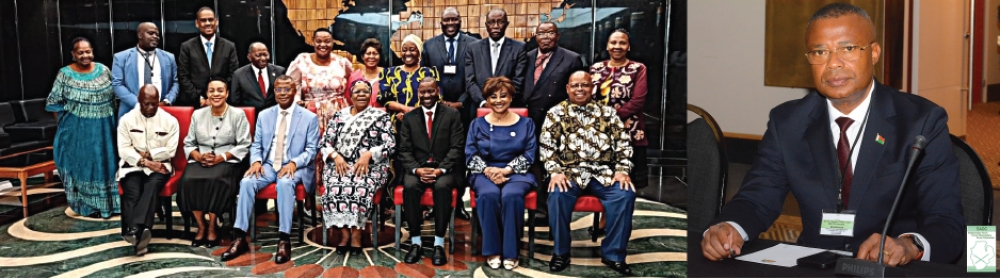
Namibia Commended for Leadership in Regional Integration
By Moses Magadza
WINDHOEK, NAMIBIA – The President of the SADC Parliamentary Forum (SADC PF), Hon. Justin Tokely, has saluted Namibia’s long-standing contribution to regional integration and parliamentary diplomacy, and called for sustained collaboration as the Forum prepares to transition into a fully-fledged regional parliament.
Speaking during a courtesy call on Wednesday by members of the Executive Committee of the SADC PF on the newly inaugurated President of Namibia, Her Excellency Madam Netumbo Nandi-Ndaitwah, Hon. Tokely congratulated her on her historic ascension as the country’s first female Head of State.
“Your recent assumption of office is a source of inspiration to our entire region. It represents a landmark victory for gender equality in African leadership,” he said.
Hon. Tokely, who is also the Speaker of the National Assembly of Madagascar, commended President Nandi-Ndaitwah’s distinguished record in governance, diplomacy, and pan-African solidarity. He described her as a “freedom fighter, seasoned diplomat, and a committed servant of the people.”
He stressed that her leadership exemplifies “dedication, integrity, and the values of African unity.”
Paying tribute to Namibia’s previous Heads of State – the late Dr. Sam Nujoma, Dr. Hifikepunye Pohamba, and Dr. Hage Geingob – Hon. Tokely acknowledged their respective roles in laying the democratic and developmental foundations upon which modern Namibia stands.
“Their cumulative leadership over three decades advanced peace, democracy, and regional integration,” he said.
He recalled that under Dr. Nujoma, Namibia played a foundational role in the establishment of the SADC PF by hosting its historic inaugural summit in Windhoek in July 1995 and generously accommodating its Secretariat since 1997.
“President Nujoma’s unwavering support for regional parliamentary diplomacy, including his vision of SADC PF as the nucleus of a future regional parliament, has guided our trajectory,” he remarked.
He noted the legacy of President Pohamba in entrenching good governance and inclusivity, noting that “nearly half of Namibia’s parliamentarians are women, a powerful testament to your nation’s progressive gender agenda.”
He also applauded President Geingob’s regional leadership, especially during his tenure as SADC Chairperson, which focused on deepening regional cooperation and economic integration.
“The Namibian example stands as a beacon of democratic governance, peace, and gender-responsive leadership. Few countries can match such a consistent commitment to human rights and gender parity,” Hon. Tokely stated.
He appreciated Namibia’s continued support to the Forum and underscored the country’s symbolic and strategic importance.
“Namibia holds a special place in the heart of the SADC PF. It has been an unwavering pillar of support since our inception,” he stated.
As the SADC PF works towards transforming into a regional parliament, Hon. Tokely called for intensified cooperation with Namibia, particularly in ensuring that regional integration efforts are people driven.
“We remain committed to ensuring that the voice of our people is heard in SADC processes and that our policies reflect democratic will. The experienced leadership and input of Namibian parliamentarians continue to enrich our deliberations,” he affirmed.
On her part, President Nandi-Ndaitwah said she was happy to “be among our Honourable Members of Parliament, particularly at a time when our region really needs the work of the parliamentarians who are our representatives.”
Notable among the SADC PF delegation were the Speaker of the National Assembly of Angola, Carolina Cerqueira; the Speaker of then Parliament of Zimbabwe, Advocate Jacob Francis Nzwidamilimo Mudenda; the Speaker of the National Assembly of Lesotho Honourable Tlohang Sekhamane; then Speaker of the National Assembly of Zambia Honourable Nelly Mutti; Honourable Dumelang Selashando, leader of the opposition in Botswana; Honourable Shally Josepha Raymond; and SADC PF Secretary General Ms Boemo Sekgoma.
Ends/.